Part two: Hydrometallurgy, chemical analysis and magnetic separation at SLR’s mineral processing laboratory
by Ben Simpson
View post
Continuing our showcase of the metallurgical testing capabilities at SLR, this article focuses on the interesting and sometimes complex worlds of hydrometallurgy, chemical analysis and magnetic separation.
You can read the first part of this article series, which talks about comminution, flotation and sample preparation, here.
Defined as “the use of aqueous chemistry for the recovery of metals from ores, concentrate and recycled or residual materials”, hydrometallurgy can be used both as a primary and secondary method of processing an ore to recover the metals of value, and is likely to become an increasingly more important part of future processing flowsheets as deposits continue to reduce in grade and become more challenging to process.
One of the most common applications of hydrometallurgy within the mining industry is for the recovery of gold (and silver) using solutions containing sodium cyanide, although the technology can also be used for the extraction of a range of other commodities including lithium, copper, nickel and cobalt.
In this video, some of the testing solutions shown are used to develop a sustainable processing solution, including agitated leach testing for CIL/CIP design, coarse ore bottle roll testing for heap leach amenability and acid leaching.
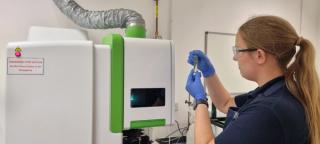
SLR has been providing in-house chemical analysis as part of our metallurgical test programs for over 15 years and has the capabilities to analyse a wide range of chemical elements. Chemical analysis is a key part of any metallurgical test program, enabling the determination of the quality (or grade) of the products generated during testing.
Built around a rapid turnaround to support our ongoing testwork projects, our laboratory has the capability to report results typically withing 24-48 hours of sample receipt whilst still maintaining the high quality needed to ensure confidence in the results.
The below video shows the multiple stages which go into the analysis of a sample, including sample preparation, chemical digestion, and instrumental analysis by both Atomic Absorption Spectroscopy (AAS) and Inductively Coupled Plasma Optical Emission Spectroscopy (ICP-OES). Also shown is Induction Furnace analysis for sulphur and carbon by LECO.
As the name suggests, magnetic separation is the process of separating the minerals within an ore based on their magnetic susceptibility, which can broadly fit into one of three categories:
1. Ferromagnetic - minerals which are strongly attracted to a magnetic field, e.g., magnetite,
2. Paramagnetic - minerals which have a weak attraction to a magnetic field, e.g., wolframite, tantalite or Ilmenite, or
3. Non-magnetic - minerals which show no attraction to a magnetic field, e.g., cassiterite, zircon, quartz.
Magnetic separation can be performed either wet or dry using both fixed intensity permanent magnets and variable intensity electromagnets. In this video, we share some of the magnetic testing capabilities that we offer at SLR which include;
- Davis Tube Testing,
- Dry Disc Electromagnetic separation,
- Wet Low Intensity Magnetic Separation (LIMS); and
- Wet High Intensity Magnetic Separation (WHIMS).
At SLR, we can assist at any stage of project development, from initial scoping through to full feasibility, to develop and optimise a sustainable processing solution.
If you would like to find out about our mineral processing services and how we can assist in providing a sustainable processing solution for your project, please contact us.
Contact us
by Ben Simpson