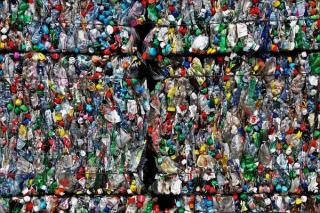
How companies are preparing for the EU’s Packaging and Packaging Waste Regulation 2025/40

Post Date
25 June 2026
Read Time
4 minutes
Plastic waste

The European Union’s Packaging and Packaging Waste Regulations (PPWR) aims to significantly reduce the environmental and health impacts associated with packaging by introducing clearer, stricter, and more uniform requirements to all operators in European Union Member States.

The focus of the EU PPWR is on:

  • Cutting packaging waste volumes
  • Making all packaging recyclable in practice
  • Increasing the use of recycled materials

What’s the scope? Does it apply to your company?

The EU PPWR has a wide scope: the Regulations apply to all packaging placed on the EU market, whether empty or filled. It covers the packaging of all products produced or imported into the European Union regardless of origin.

The Regulation applies regardless of a company’s sector and role in the supply chain.

Are there any exemptions?

Some exemptions exist within PPWR, notably:

  • The recyclability, recycled content, and reuse targets for packaging used for the transport of dangerous goods
  • The recyclability requirements for immediate packaging, which is in direct contact with medicinal products, extended to contact packaging in some cases
  • The recyclability requirements for contact-sensitive plastic packaging for medical devices, contact-sensitive packaging of foods intended for infants and young children, and food for special medical purposes
  • Sales packaging made from materials such as lightweight wood, cork, textile, rubber, ceramic or porcelain

What’s considered packaging within PPWR?

Packaging is defined broadly as any item intended for containment, protection, handling, delivery, or presentation of products, including its components. However, items that form an integral part of a product and are disposed of together with it are excluded from the definition.
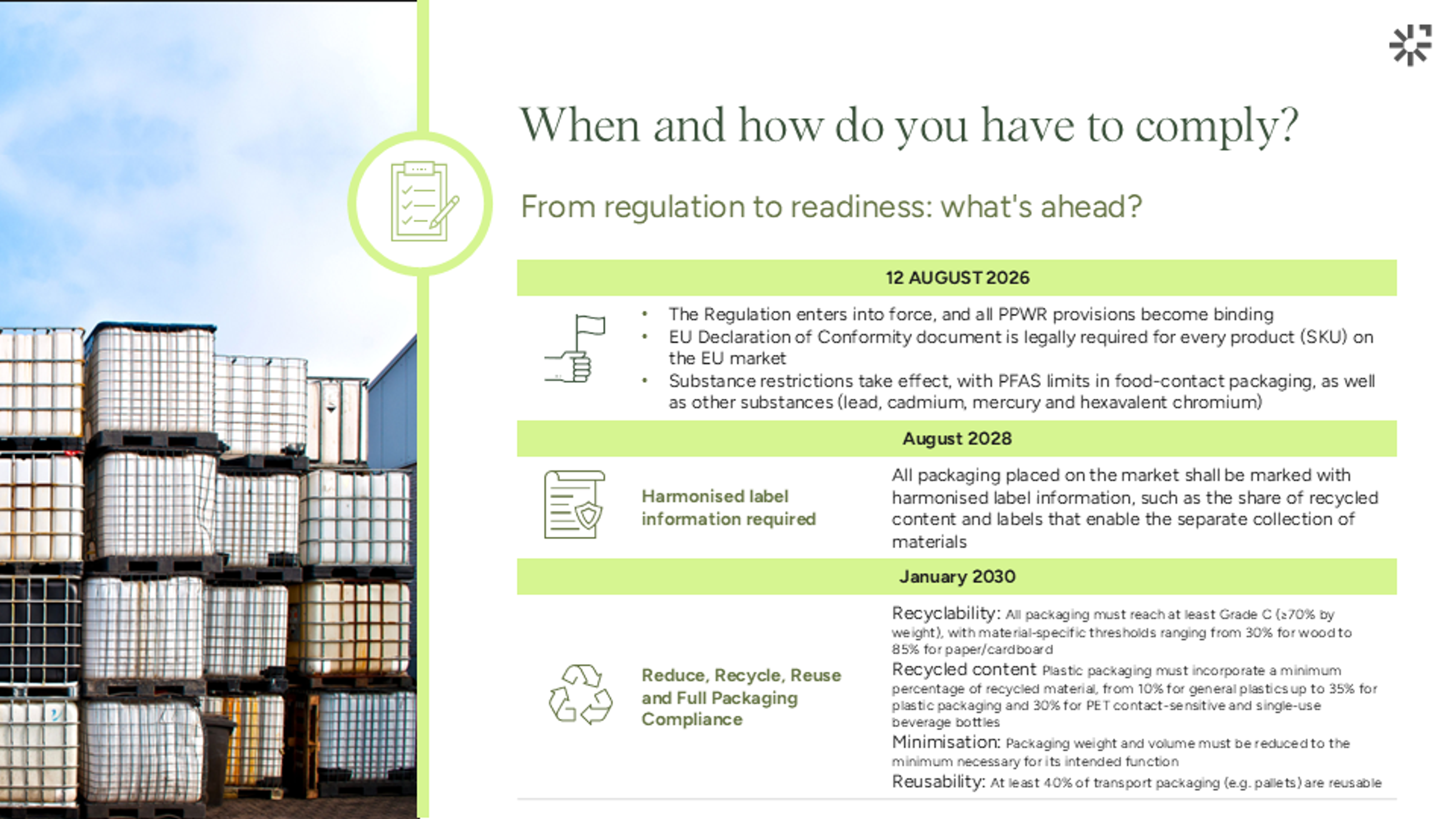
What do I have to comply with and by when?

Visual depiction of the deadlines for compliance

12 August 2026

  • The Regulation enters into force, and all PPWR provisions become binding
  • EU Declaration of Conformity (DoC) document becomes legally required for every piece of packaging on the EU market
  • Substance restrictions take effect, with PFAS limits in food-contact packaging, as well as other substances (lead, cadmium, mercury and hexavalent chromium)

August 2028

  • All packaging placed on the market shall be marked with harmonised label information, such as the share of recycled content and labels that enable split collection of materials

January 2030

  • Recyclability
    • All packaging must achieve at least Grade C (≥ 70% recyclability by weight)
    • Material-specific targets with Plastics: ≥ 55%, Wood: ≥ 30%, Ferrous metals: ≥ 80%, Aluminium: ≥ 60%, Glass: ≥ 75%, Paper/cardboard: ≥ 85%
  • Recycled content
    • Any plastic part of the packaging shall contain a minimum % of recycled content;
      • 30% for contact-sensitive packaging made from PET and 10% for other plastic materials
      • 30% for single-use plastic beverage bottles
      • 35% for plastic packaging
  • Packaging minimisation
    • Packaging placed on the market should be designed so that its weight and volume are reduced to the minimum necessary
  • Re-use of transport packaging
    • 40% of all transport packaging (e.g. pallets) shall be reusable

What should you be doing now?

Understand your baseline

Start mapping all packaging formats and specs (materials, weights, suppliers). Identify non-recyclable or difficult-to-recycle formats, and flag contact-sensitive applications.

Identify your exposure

Flag which formats do not currently meet the recyclability criteria and are below the upcoming recycled content targets. Understand which packaging is at risk of non-compliance.

Start redesigning

Remove problematic materials and Substances of Concern. Reduce packaging volume where unnecessary and align with the Design for Recycling principles.

Engage with key stakeholders

Start conversations with your suppliers and value chain partners to secure the right materials. Design a roadmap that guides next steps to your phased-in approach to compliance.

How SLR can help

Companies that stay ahead of evolving requirements, including recyclability, packaging optimisation and labelling, will maintain a compliant, future-ready position in their industry.

SLR helps organisations achieve PPWR compliance through a clear, practical and results-focused approach. We partner with your teams to tailor deliverables to each of your specific needs, sector, context and pace, we understand it’s not a one-size-fits-all model.

Get in touch with our team

Recent posts

  • Plastic waste
    Insight

    25 June 2026

    4 minutes read

    How companies are preparing for the EU’s Packaging and Packaging Waste Regulation 2025/40

    by Marion Briggs, Stuart Moroney, Stéphanie Finet


    View post
  • Insight

    23 June 2026

    8 minutes read

    Key strengths and gaps in Australia’s National Climate Scenario Guidance: What this means for your analysis

    by Henry Partridge, James Balik-Meacher


    View post
  • Aerial view of road with lorries and other traffic. There is a digital pattern over the top.
    Insight

    19 June 2026

    6 minutes read

    How journey planning and telematics systems can optimise fleet operations

    by Paul Curtis, Paul Green


    View post
See all posts