
SBTi Corporate Net-Zero Standard Version 2.0
by Jovontae Catline , Caroline Dolan, Joe Sarvary, Liz Whinnett
View post
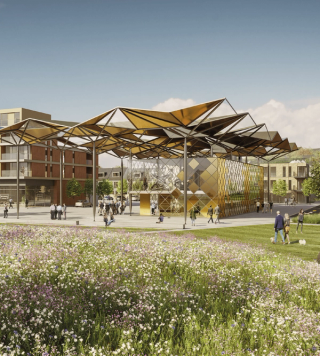
For decades, planning has been shaped by car-dependent developments, constrained by projected demand rather than long-term ambition.
But with increasing pressure from net zero commitments, government housing targets combined with rising expectations around liveability and public health, there is a growing need to rethink our planning assessment methods.
As the UK moves forward with large-scale developments and a new generation of towns, there is a clear opportunity to adopt an approach that defines outcomes first, then designs to achieve them.
This is where SLR’s vision-led planning tool, Flint, comes in. Aligned with the National Planning Policy Framework (NPPF), a vision-led approach represents a direct investment in people and place rather than cars. It also assigns greater importance to external environmental, social and health benefits over protecting the convenience of the car driver.
The traditional “predict and provide” model remains dominant in UK planning. While it can support faster approvals in the short term, it often leads to suboptimal outcomes that require costly interventions later or face delays at public inquiry.
At its core, this approach forecasts traffic growth and expands capacity to meet it. In doing so, it locks developments into a cycle that reinforces car dependency rather than reducing it.
The result is familiar: increased congestion and emissions, poorer quality places and rising infrastructure costs that undermine scheme viability. In many cases, projects grind to a halt when major highway interventions become a requirement for delivery.
Planning has long focused on accommodating traffic. The challenge now is to accommodate growth without increasing it. We know that walking, cycling, public transport - and carpooling - are more space-efficient modes. With limited funding available for major highways infrastructure, investment in alternative modes is also more viable thanks to their lower cost and environmental impact.
As the industry shifts towards more sustainable, people-focused outcomes, a vision-led approach offers a way to de-risk delivery by designing places where people simply don’t need to drive as much. That simultaneously results in accessibility and inclusivity gains.
Vision-led planning starts with the desired outcomes of a place, not predicted vehicle movements. It aligns land use, transport and sustainability from the outset, designing for people rather than cars.
At SLR, we have developed Flint to bring this approach into practice. The tool integrates national and regional datasets with analysis of amenity, air quality, health impacts, carbon emissions and placemaking. It also considers mobility interventions and trip generation, creating a comprehensive evidence base for decision-making.
Framed around four core pillars of climate, health, accessibility and inclusion, Flint:
• establishes a clear vision centred on liveability
• designs the masterplan to deliver against that vision
• uses data and modelling to test whether outcomes can be achieved
While vision-led planning can feel abstract, Flint provides a structured way to bring clarity and accountability to the process. It gives both local authorities, masterplanners and developers the confidence to move towards a new model of placemaking grounded in measurable outcomes.
One of the most persistent challenges in planning is the gap between ambition and delivery. Strong visions are often diluted as schemes progress through design, assessment and approval.
Flint helps bridge this gap by translating high-level ambitions into measurable outcomes that can be tested and evidenced throughout the planning process. It supports informed decision-making, allowing stakeholders to understand trade-offs between infrastructure, placemaking and mobility strategies.
This also strengthens alignment with policy. By clearly demonstrating how proposals support sustainable transport and reduced car reliance, the approach helps meet National Planning Policy Framework objectives in a transparent and quantifiable way.
Rather than remaining a theoretical framework, vision-led planning becomes a practical tool for delivery.
Sustainable communities are not defined solely by infrastructure, but by how people live and move within them. Behaviour change sits at the heart of this shift, and behaviour is shaped by design.
Reducing car reliance is not about restriction, but about accessibility, inclusivity and proximity. When daily needs are within easy reach, people naturally make different choices about how they travel.
Higher density, mixed-use development supports local living, while well-designed environments make walking, cycling and public transport the most convenient options.
Evidence consistently shows that where community services are within a 15-minute walk, most trips are made on foot. In this context, good planning reduces the need for vehicles.
The starting point, therefore, should be to apply credible data sources to show how people behave, before considering how vehicles move.
A vision-led community is one where placemaking and mobility work together to support everyday life.
From a placemaking perspective, this includes walkable neighbourhoods, safe and inclusive streets and easy access to retail, leisure and community spaces. Local employment opportunities, flexible working hubs and schools integrated into the community all contribute to a stronger sense of place.
From a mobility perspective, success means prioritising active travel, integrating public transport and enabling low-emission options. This might include mobility hubs, shared transport services and infrastructure that supports electric vehicles.
Emerging schemes such as Gomm Valley and Monkton Heathfield offer early examples of how these principles can be applied in practice. In both cases, new methodologies have supported planning consent by demonstrating how sustainable outcomes can be achieved by applying alternative transport data and assumptions.
Tools like Flint play a key role in this process, providing the evidence needed to demonstrate both viability and deliverability.
Changes within the planning and construction sector are rarely straightforward. Established processes, risk aversion and limited precedent can slow progress.
A cautious approach from planning and highway authorities, combined with a lack of consistent definitions around vision-led planning, can make it harder to build confidence. There is also a need to address skills gaps as new approaches and tools are introduced.
A critical challenge lies in measurement. Without clear, quantifiable outcomes, visions can become diluted as schemes evolve, often reverting to worst-case scenario thinking.
Bringing stakeholders along the journey is therefore essential, particularly local authorities, who play a central role in shaping and approving development.
This shift is not theoretical. It is essential to meeting net zero targets, delivering on housing demand and addressing wider challenges around public health and social equity.
With a new generation of towns and large-scale developments on the horizon, vision-led planning needs to be fully embraced. The tools and data now exist to turn ambition into reality which is being demonstrated through the deployment of Flint.
Delivering this shift will require confidence, collaboration and a willingness to rethink established approaches. The outcome, however, is clear: better places, delivered more efficiently and designed around people rather than cars.
It was fantastic to share more at UKREiiF 2026 about our vision-led planning approach and how it’s helping unlock the next generation of sustainable communities.
SLR brought this challenge to the forefront through a lively and thought-provoking panel, featuring leading voices from across the industry and explored how Flint is putting vision-led at the heart of planning can create more resilient, future-ready places. The panel included:
A big thank you to everyone who joined us at Pavilion 5 and contributed to the discussion. The level of engagement reinforced just how important this shift is for the future of development.
Watch the highlights below to hear the key insights and perspectives from the panel.
by Jovontae Catline , Caroline Dolan, Joe Sarvary, Liz Whinnett

by James Balik-Meacher, Sophia Davison, Miguel Oyarbide

by Selina Roman-White, Valeria Alvarado Tejeda, Madison Edson, James Van Horne, Craig Bock, Matthew Mitchell